

Blog · 2026-10-16
AI Exclusions in Architects' Professional Liability Insurance: What to Ask Before Renewal
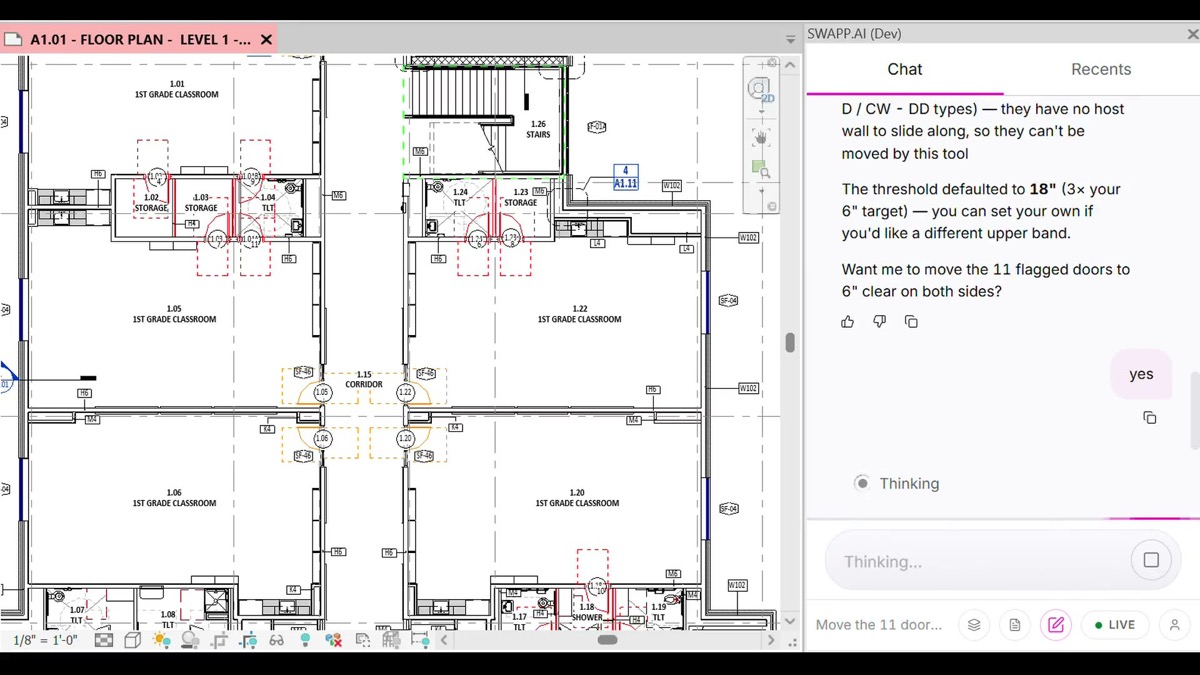
Something changed in the fine print this year, and we don’t think many architecture firms have noticed yet. Insurers have started writing artificial intelligence into their exclusions. So far most of the standardized wording sits in general liability forms, but the same conversation is reaching errors-and-omissions cover, and it usually comes up at renewal, one firm at a time.
We aren’t insurance people. We build AI that works inside Revit and Archicad, so we watch closely how the profession is settling who answers for AI-assisted work. Below is what we could confirm from published sources, what we think it means for a practice, and the questions we’d take to a broker.
This is general information, not legal or insurance advice. Policies differ, and so do states. Talk to your broker and your attorney about your own coverage.
What changed in policy language
The clearest change is standard wording. Verisk, through its ISO forms program, introduced three optional generative AI exclusion endorsements for commercial general liability, effective January 2026: CG 40 47, CG 40 48 and CG 35 08 (Big “I”, Business Insurance). According to Insurance Journal, CG 40 47 excludes bodily injury, property damage and personal and advertising injury arising out of generative AI, CG 40 48 excludes only the personal and advertising injury part, and CG 35 08 applies to products and completed operations.
Two caveats matter for architects. These are general liability forms, and professional liability (the policy that responds when a client says your drawings were wrong) is a separate product with its own wording. The forms are also optional, so each carrier decides whether to use them. In April 2026 a broker told Business Insurance the market was “just at the very beginning,” with “a few carriers” starting to adopt them.
Professional lines are moving too, unevenly. Insurance Journal reported in July 2026 that one carrier had introduced an “absolute” AI exclusion across its D&O, E&O and fiduciary liability products. A coverage lawyer quoted in the same piece expected E&O and D&O to be where AI exclusions get applied and tested first. She also noted that traditional policies may still cover AI-related risk where it isn’t explicitly excluded, and that some insurers may choose to price the risk, probably for additional premium, instead of excluding it.
In the policies we’ve seen discussed, AI-assisted work is usually still covered because the wording says nothing about AI either way. That silence is what’s being reopened, renewal by renewal.
Who owns an AI-assisted drawing
That answer hasn’t changed. The licensed professional who stamps the drawing owns it, whether AI touched it or not.
NCARB’s board said so in its 2024 statement on AI in practice: any regulation of AI use must keep the licensed practitioner in control and accountable for work submitted under their seal, and whatever AI tools are used, the architect is still responsible for services that meet the standard of care. In an AIA Trust article, Damon Leverett, AIA, put it more plainly: “We can’t shift responsibility onto a machine; that’s not allowed and never has been.”
So insurers are asking an old liability question, and the new part is that they’re pricing it in. For two years the AI conversation in AEC has been about speed: how much it can automate, how many hours it can save. Accountability was always going to be the harder question, and now it shows up in policy forms.
What insurers may ask at renewal
We can’t predict what your carrier will ask. Business Insurance reported that underwriters have moved from asking whether an insured uses AI to asking which models it uses, how those decisions were made, and what “checks and balances” confirm the results are accurate and verifiable. For a design firm, we’d expect that to turn into questions like these:
- Which AI tools touch your models, drawings or specifications, and on which projects?
- Does a licensed professional review AI-assisted output before it’s issued?
- Can you show what was reviewed, by whom, and when?
- Is there a written AI-use policy for staff, and has anyone been trained on it?
- Do your client contracts say anything about AI?
The contract question is easy to skip. A recap from law firm MG+M of its April 2026 roundtable for design firms noted that “AI use raises important contractual and risk allocation considerations,” including how responsibilities are split between project stakeholders.
Documenting review and approval
The firms that come through this well will have one thing in common: they can show their work. That means a human in the loop, a record of what was reviewed and approved, and output a person actually stood behind before it went out the door. The same MG+M recap says human judgment and oversight “remain essential” and that “documentation will be increasingly important” in showing how AI tools are used.
In a practice, that comes down to a few habits:
- Prefer tools whose changes you can review before they land. A tool that proposes and waits for approval is easier to account for than one that edits the model on its own.
- Keep a log of what the AI did, in which model, at whose request, and who accepted it.
- Write the review step into your QA/QC process, the way you already record a redline check before an issue.
- Decide which tasks AI is cleared to run and which stay with people, and write that down.
We built Frank, our AI Architect, around this. Frank works on the live Revit or Archicad model your team already uses, proposes changes you review before approving, and every action is visible and traceable. Its guidelines audit, for example, checks a sheet against your firm’s standards, reports pass or fail per rule, and changes nothing until you approve. More on that is on the Frank page, and our approach to data and security is on the security page. The AI and the Architect session goes through how one firm decided which documentation tasks AI was cleared to run and which stayed with the architect.
If your team builds its own AI tools, the same review-and-record question applies to them. We wrote about where firms tend to draw that line in build vs. buy AI for architecture firms.
Questions to ask your broker
- Does our professional liability policy cover claims arising from AI-assisted work today? Does any endorsement mention AI, machine learning or generative AI?
- Is our carrier adding, or planning to add, an AI exclusion at our next renewal?
- If an exclusion is proposed, how does it define AI? Would it reach the ordinary AI features inside our authoring and office software?
- Is affirmative AI coverage available, and what would it cost?
- What would the carrier want to see from us, in writing, to keep AI-assisted work covered?
- Do our general liability and cyber policies carry AI exclusions as well?
If you only have time for one, ask this before your next renewal: does our policy still cover AI-assisted work, and what do we need to document to keep it that way?
We think this shift is good for the profession. The question is moving from how much the AI did to whether you can account for what it produced, and that rewards the review habits careful firms already have.